In the Southeast Asian expansion landscape, Vietnam has always been an exceptionally attractive market. With a population of more than 100 million, Vietnam is becoming a favored destination for the relocation of global manufacturing. Its economy is growing rapidly, while e-commerce, digital payments, and mobile internet continue to expand. So, how strong is Vietnam’s market growth potential? And how can SMS and voice services be used to reach Vietnamese customers efficiently? This article analyzes Vietnam’s macroeconomic environment, digital economy, telecom operator landscape, and communications compliance requirements.
Image source: unsplash.com
I. Accelerating Digital Economy, Releasing the Dividends of Market ExpansionA population of 100 million, with young consumers driving spending growthAccording to the United Nations, Vietnam’s population reached 102 million in October 2025, ranking 16th globally. The median age is 33.4, while people aged 18–64 account for approximately 63.0% of the total population. Vietnam is therefore in a favorable stage characterized by an abundant labor force and continuously expanding consumer purchasing power, providing a sustained user base for e-commerce, fintech, gaming, and broader entertainment industries.
GDP surpasses USD 500 billion, leading ASEAN growthAccording to an International Monetary Fund (IMF) report, Vietnam’s nominal GDP reached USD 484.7 billion in 2025 and is expected to reach USD 511.1 billion in 2026, with GDP per capita of approximately USD 4,965. Vietnam’s economic growth rate is also among the fastest in Asia and leads ASEAN. In the first half of 2026, Vietnam’s economic growth exceeded expectations, prompting the IMF to raise its forecast for Vietnam’s 2026 GDP growth to 7.5% in a July report.
A USD 72.1 billion digital economy, with e-commerce as a core pillarVietnam’s digital economy has gained strong momentum in recent years. According to Vietnam’s Ministry of Science and Technology, the country’s digital economy was worth approximately USD 72.1 billion in 2025, accounting for 14.02% of national GDP. E-commerce is its most important pillar. Data from the Authority of Industry and E-commerce under Vietnam’s Ministry of Industry and Trade (iDE) shows that Vietnam’s e-commerce market reached approximately USD 31 billion in 2025, up 25.5% year over year and accounting for 10% of total retail sales and consumer services nationwide.
Rapid growth in mobile payments makes smartphones the key connection pointAccording to the State Bank of Vietnam, the number of non-cash payment transactions increased by 42.21% year over year in 2025, while transaction value increased by 22.65%. Transactions conducted through internet channels grew by 53.95% in volume and 35.75% in value. QR-code transactions increased by 50.94% in volume and 124.06% in value. These figures show that Vietnamese users are shifting from cash withdrawals toward digital payment methods such as mobile banking and QR codes. Smartphones have become the connection point for both transactions and identity verification.
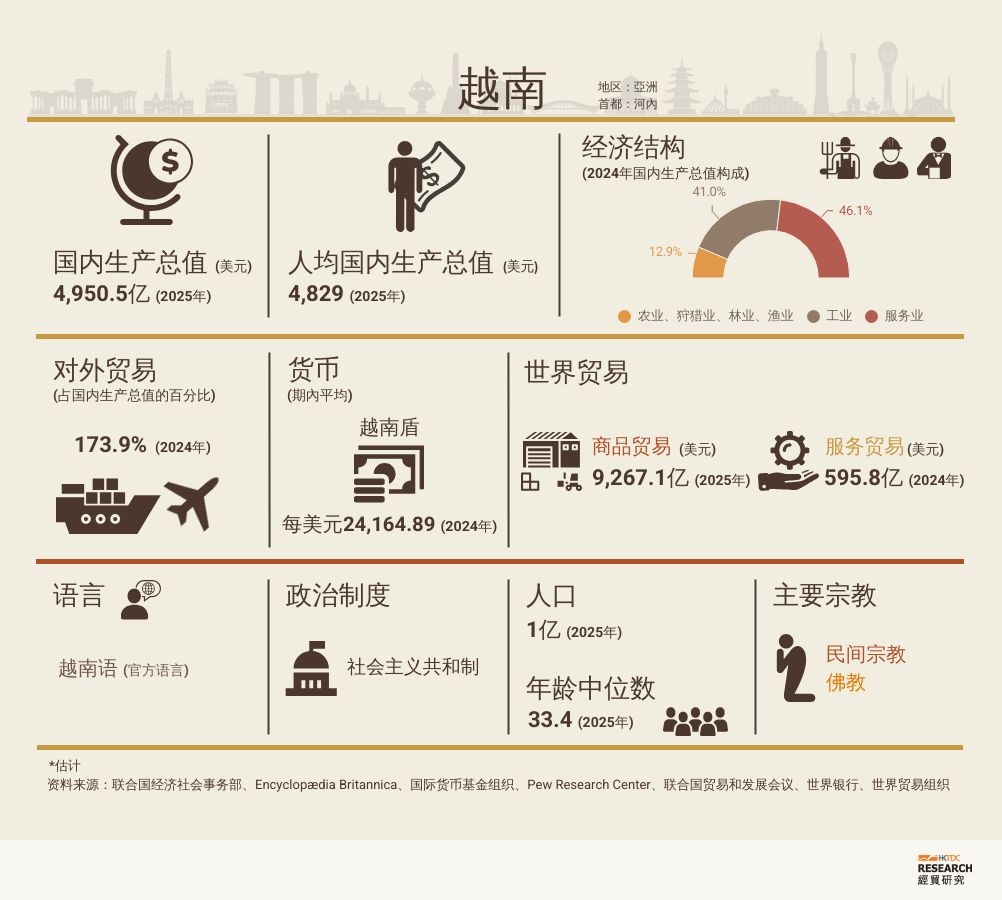
Image source: HDTDC
In short, Vietnam has developed into a typical high-growth market characterized by a population of more than 100 million, a rapidly growing economy, and fast-expanding digital industries. This growth brings not only increases in online transaction volume and value, but also growing communications needs for user registration, login verification, payment confirmation, order notifications, risk verification, and after-sales services.
II. Three “National Champions”: A Rare Telecom Operator LandscapeAccording to GSMA data, the number of mobile connections in Vietnam reached 137 million by the end of 2025, equivalent to 134% of the total population. Multiple SIM cards per person are common. Vietnam’s telecom market is now highly saturated, with its huge existing user base shared among three “national champions”—one of the most distinctive features of the Vietnamese mobile communications market.
Viettel: Affiliated with Vietnam’s Ministry of National Defence, Viettel is the country’s largest telecom operator. It covers many rural areas that other operators cannot reach. Its mobile subscriber market share is as high as 56.6%, exceeding the combined share of VinaPhone and MobiFone.
VinaPhone: Affiliated with the Vietnam Posts and Telecommunications Group (VNPT), VinaPhone is Vietnam’s second-largest operator. Its network is highly competitive in urban and suburban areas, and its mobile subscriber share stands at 22%, firmly ranking second.
MobiFone: Vietnam’s third-largest mobile operator, founded in 1993 as the country’s first GSM operator, has been directly managed by Vietnam’s Ministry of Public Security since 2025. It holds an 18.5% share of mobile subscribers.
In addition, in April 2025, SpaceX’s Starlink received a pilot license from the Vietnamese government to provide satellite internet services, becoming the first foreign company to receive such authorization. This introduced a new variable into Vietnam’s communications infrastructure. However, for the vast majority of companies expanding overseas, the three major operators remain the only channels for reaching Vietnamese users. Overall, choosing a service provider such as ITNIO TECH, which is connected to local operators and has the ability to handle local filing and compliance requirements, is fundamental to ensuring communications quality in Vietnam.

Image source: unsplash.com
III. With Internet Penetration at 84%, Why Are SMS and Voice Still Foundational?According to DataReportal, Vietnam had 85.6 million internet users at the end of 2025, representing an internet penetration rate of 84.2%. The country also had 79 million active social media users, including approximately 79 million Facebook users and 76.1 million adult TikTok users. The local super app Zalo had monthly active users equivalent to nearly 80% of the total population. Judging by these figures, Vietnam is clearly a highly internet-connected market. However, just as in other highly penetrated markets such as Mexico and the United States, the more people use the internet, the more they still rely on SMS. This is a defining reality of Vietnam’s digital economy.
First, SMS and voice verification are legally recognized authentication methods. The State Bank of Vietnam imposes strict requirements on online banking, mobile payments, and financial lending services. Higher-risk transactions generally require verification through OTPs, biometric identification, or electronic signatures, and certain scenarios require combined authentication. When customers change authentication-related information such as their phone number or identification documents, verification must combine biometric identification with compliant methods such as OTP or voice verification. SMS and voice are the most basic and widely implemented forms within this system.
Second, strict spam regulation makes compliant SMS a scarce trust channel. In Vietnam, any advertising SMS, phone call, or email sent in violation of regulations is treated as spam. Numbers used to send such messages may be blocked and may also face fines exceeding USD 3,000. In this context, compliant SMS sent under a registered brand name naturally becomes a trusted communication channel, providing built-in brand endorsement.
Third, SMS and voice are essential for time-sensitive scenarios. For repayment reminders, logistics deliveries, and order confirmations, SMS does not depend on internet access or the installation of any app. Even in a highly connected country like Vietnam, network fluctuations and uneven coverage in mountainous and island areas remain real challenges. SMS and voice therefore continue to serve as the most reliable fallback channels.
Finally, operator channels offer traceability and audit advantages. Although Vietnam has a nationwide local communications tool, Zalo—which serves personal social functions as well as enterprise services, government notifications, and commercial outreach—operator channels remain the regulatory standard for high-trust scenarios such as financial account opening, payment verification, and judicial or government notifications because of their traceability and audit-record capabilities.
Image source: unsplash.com
IV. Practical Communications Compliance in Vietnam: Four Key PreparationsVietnam’s rapidly growing digital economy is certainly attractive. However, as one of the world’s most tightly regulated communications markets, Vietnam requires companies to make four key preparations before using SMS and voice to support business growth.
1. Brand-name registration and compliant sending are the first requirementsAs mentioned above, companies that want to send commercial SMS messages or make business calls in Vietnam must use a registered brand name and file the URLs and domains included in their SMS messages. Marketing messages must also follow the “prior consent” principle. Sending marketing messages to users who have not provided consent or who are on the “Do Not Receive Advertising” list may result in message interception, user complaints, and substantial fines. Companies must also comply with restrictions on marketing frequency and timing. Sending marketing messages too frequently to the same user or contacting users during rest periods is prohibited.
2. Recognize the value of phone numbers and strengthen risk controls in a SIM-registration environmentSince 2023, Vietnam has completed the verification and cross-checking of information for 125 million mobile users against the national population database. In 2024, it launched a major cleanup of “junk SIMs.” Operators and their CEOs are held responsible for non-compliant new SIM cards, and violations may result in the suspension of authorization to add new users. This means that the identity reliability of Vietnamese mobile numbers is much higher than in most emerging markets. A phone number is effectively an identity marker and one of the most reliable anchors for registration, credit approval, debt collection, and other processes. At the same time, the 134% mobile connection rate means that multiple SIM cards per person are common. Companies should therefore establish a combined risk-control system based on phone number, OTP, device fingerprinting, and behavioral recognition.
3. Vietnamese localization and AI-powered voice outreachVietnamese is Vietnam’s only official language. SMS and voice content must therefore use natural, authentic Vietnamese to ensure readability and user trust. In scenarios such as financial collections, logistics delivery confirmation, and customer follow-ups, voice outreach is far more efficient than SMS. For example, ITNIO TECH’s AI Voice Agent has been deeply optimized for Vietnamese speech and can simulate multi-turn conversations with users in Vietnamese, significantly reducing the labor and operational costs of cross-border teams.
4. Incorporate the Personal Data Protection Law into communications compliance preparationsIn 2026, Vietnam’s new Personal Data Protection Law formally came into effect. It clarifies that “silence does not constitute consent” and requires companies to conduct and file impact assessments for cross-border data transfers. Illegal cross-border transfers may result in fines of up to 5% of the previous year’s revenue, while other violations may incur fines of up to USD 115,000. Therefore, when sending verification codes, managing marketing subscriptions, and retaining communications logs, companies must implement consent records, data minimization, and compliant cross-border data-transfer procedures.
In Vietnam, where rapid digital-economy growth intersects with extremely strict communications regulation, market dividends belong only to companies that make compliance a core capability. SMS and voice remain the central trusted links connecting businesses with Vietnamese users. However, these links must be protected by three layers: registered brand names, real-name SIM registration, and data compliance.
ITNIO TECH continues to develop communications resources across Southeast Asia. With high-quality routing through local operators, end-to-end support for brand-name registration and filing, and an AI Voice Agent capable of localized Vietnamese interaction, ITNIO TECH helps overseas companies achieve stable, efficient, and trustworthy customer outreach in the Vietnamese market.